
Pakistan's hawkish Army chief Gen Ashfaq Parvez Kayani, who did little to change the force's India-centric stance, will leave the world's sixth-largest army grappling with a host of security challenges when he steps down on Friday.
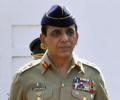
The name of Pakistan Army chief Gen Ashfaq Parvez Kayani's successor will be announced a day before he retires on November 29, Information Minister Pervaiz Rashid said on Friday.

'A close look at the time-lines tells you that exactly as the back-channel negotiations were in their most crucial stage, "somebody" was planning the 26/11 attacks in Mumbai,' says Shekhar Gupta questioning Khurshid Mahmud Kasuri's account of a peace deal with India.

With Pakistan's powerful army chief Gen Ashfaq Parvez Kayani's term coming to an end in November, names of top generals who are likely to succeed him are being discussed in the political circles and in the corridors of power.

Lt Gen Haroon Aslam of the Pakistan Army on Thursday resigned a day after he was superseded by his two juniors who were made the new army chief and the chairman joint chief of staff committee.
The appointment of General Raheel Sharif as the new army chief of Pakistan has come as a surprise to many. Rajiv Dogra, former ambassador and India's last Consul General to Karachi, speaks to Aabhas Sharma about the appointment, what it says about the priorities of Pakistan Prime Minister Nawaz Sharif and most importantly, what it means for India.
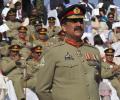
'Already, there is talk of a possible extension for Raheel Sharif in the context of his perceived sterling, but incomplete work in the war against terror, as also the cleansing of crime and extortion networks in Karachi,' says Rana Banerji.

Gen Sharif had earlier promised to bow out at the end of his term in November this year.

'It is not difficult for a Pakistan army chief assisted by the deep state to manipulate a situation.' 'Pulwama, Uri and Pathankot, all come to mind,' cautions Lieutenant General Syed Ata Hasnain (retd).

Violations from the Pakistani side along the Line of Control have become a common recurrence, and according to sources in the Intelligence Bureau, some peace can be expected only after Pakistan Army Chief Gen Ashfaq Parvez Kayani retires next month.

Experts trace the reasons for the 26/11 attacks to the Pakistan's military interest in three key areas: Kashmir, Afghanistan and nuclear armaments.

'A resurgent Jaish could be a reflection of the Pakistani security establishment's view that with the region moving ever closer to a post-US Afghanistan, it is time to redirect attention to Kashmir.'

General Qamar Bajwa, his colleagues say, is a firm opponent of extremism and terrorism. He may prove even more forceful in the fight against terrorism than his predecessor, who is credited with launching Operation Zarb-i-Azb, which helped lower the frequency of terrorist attacks.

'Pakistan is full of 'religious entrepreneurs' like Hafeez Saeed who poison the minds of the young so that they can be motivated to become terrorists. They work in concert with the rulers of Pakistan. It is a private-public partnership.'
